

Liou Yih-Cherng
- Research activities
- Grants
- My notes
Academic Qualifications
D. Phil. (Queen’s, Canada), B. Sc. (NTOU, Taiwan)Major Research Interests
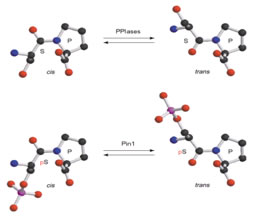
The phosphorylation of specific proteins on Ser/Thr residues preceding proline is thought to be a major cellular signaling mechanism; however, very little is known about how the phosphorylation actually regulates protein function. Pin1 is an 18 kDa protein with two domains: the N-terminal WW domain (named after two invariant Trp residues, amino acids 1-39) and the C-terminal PPIase domain (amino acids 45-163). The WW domain acts as a binding module to bind its substrate via the phosphoserine (p-Ser) or phosphothreonine (p-Thr)-proline motifs in its substrates. The C-terminal PPIase domain is the catalytic domain to isomerize the conformational changes of specific pSer/Thr-Pro motifs. Unlike other peptidyl-prolyl isomerases (PPIases), Pin1 is a unique peptidyl isomerase that recognizes only the phosphorylated Ser/Thr motif preceding a proline residue. In addition, Pin1 is very prominent in isomerizing the cis-trans conformation of prolyl-peptidyl bonds in its substrates, resulting in regulation of their biological functions, suggesting the conformational changes mediated by Pin1 or Pin1-like isomerase may be crucial for the normal functioning of cells.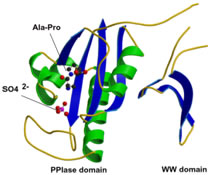
NO matched positions found for you!