

A big step toward academic and professional success is pursuing a postgraduate degree (i.e., master’s or doctoral program). These advanced programs are typically referred to as graduate programs (usually in the USA and Canada), higher degree by research (HDR, usually in Australia), or postgraduate programs. They provide access to intellectual development, specialized employment, and research opportunities. However, being admitted necessitates planning and strategy in addition to ambition. The first step is to comprehend the procedure. Universities seek applicants with potential and a purpose so that the competition pool can be fierce. To stand out in this competitive process, admission optimization is essential. This blog examines how to improve your prospects for getting accepted to a master’s or doctoral program.
The Value of Postgraduate Degrees
Pursuing a master’s or doctoral program is a strategic investment that enhances expertise and opens doors to diverse career opportunities. A master’s degree equips graduates with industry-relevant skills, preparing them for leadership roles in fields such as business, technology, healthcare, and education. It offers immediate professional benefits, including greater job mobility and earning potential. In contrast, a doctorate provides deep specialization, encouraging original research (in a PhD) and the development of advanced problem-solving and critical thinking skills. These competencies are highly valued in academia, research institutions, government, and innovative industries where complex decision-making and intellectual rigor are essential.
Doctoral programs cultivate resilience, independence, and intellectual leadership. For instance, PhD graduates often take on roles as professors, researchers, or policy advisors, contributing to knowledge creation and innovation. Their ability to challenge assumptions and produce original insights is especially valuable in specialized fields like artificial intelligence, biology, and theoretical mathematics. Master’s graduates typically excel in strategic, technical, and managerial roles, leveraging their training across sectors such as finance, engineering, and education. Ultimately, both degrees foster lifelong learning, creativity, and the confidence to navigate complex challenges. These are the qualities that drive success in an evolving global landscape.
Understanding Postgraduate Program Admission Requirements
Typical requirements include a tertiary qualification such as a bachelor’s or master’s degree, academic transcripts, language proficiency test scores, a personal essay (such as a statement of purpose, motivation letter, cover letter, or personal statement), and recommendation letters. The admission criteria for master’s programs are generally less demanding than those for doctoral programs. For instance, most universities in the USA require a minimum IELTS score of 6.5 for PhD applicants (with higher scores often needed for funding), while a minimum score of 5.5 is usually sufficient for master’s applicants. Keep in mind that the best universities in the world expect even stronger qualifications.
Requirements for Master’s Program
A bachelor’s degree in a related field of study is typically required for admission to a master’s program. Among the admission criteria, your bachelor’s GPA usually carries the most weight. Most universities require a minimum GPA of around 75 percent, which is equivalent to 3.0 out of 4 in the US and Canadian systems, or 15 out of 20 in countries like Iran, France, and Belgium. The next most important factor is your language proficiency test results. Depending on the country where you plan to study, you may need to take an English, German, or French language test. In most cases, an English test such as IELTS or TOEFL iBT is sufficient.
Requirements for Doctoral Program
A master’s degree in a related discipline is typically required for admission to a doctoral program; however, if you are applying for a direct PhD or a direct professional doctorate, a bachelor’s degree is sufficient. A high GPA reflects your academic and analytical abilities, which are essential for success in graduate studies. For PhD and professional doctoral applicants, the master’s GPA is often the most important credential. English proficiency test (e.g., IELTS or TOEFL iBT) and standardized test scores (e.g., GRE or GMAT) are required by many doctoral programs. Research experience and publications resulting from your master’s thesis are also significant. Additionally, your personal essay and recommendation letters play a crucial role.
Competitive Applicant Pools
The applicant pool for doctoral programs is more competitive and international than that for master’s programs, primarily because most doctoral applicants (especially PhD applicants) seek financial aid, while master’s students often self-fund their studies. Success in doctoral admissions requires standing out rather than simply meeting the minimum requirements. Your peers may have specialized technical skills, international research experience, or diverse academic backgrounds. To distinguish yourself, you should highlight in your application what makes your master’s achievements unique and demonstrate your readiness for doctoral research. Strong performance in quantitative courses, laboratory work, or theoretical studies adds weight to your profile. Emphasizing advanced courses you have taken that are relevant to your doctoral objectives can help to further validate your expertise.

Admission Optimization For Master’s and Doctoral Programs
You have to make sure that you meet the minimum requirements of the universities you are applying to, even if you are self-funding your studies. When applying for funded master’s or doctoral programs, meeting minimum requirements is not enough, and you should have a competitive CV. For example, the minimum requirement for the TOEFL iBT total score for a chemical engineering doctoral program might be 86, but for winning a TA assistantship in the USA, you need a TOEFL score of at least 100. After starting to prepare for language tests, the second step in optimizing your admission process is identifying the universities where your CV meets their requirements and can compete with other applicants.
How to Find Suitable Universities For Your CV
Both master’s and doctoral applicants need to know which universities their CVs are suitable for. For instance, if you have a master’s GPA of 3.2 out of 4 with an IELTS score of 6, you should not apply to Stanford University or the University of Cambridge because you do not meet their doctoral programs’ minimum requirements. Traditionally, evaluating the strength of your CV involves comparing it with those of previously successful applicants, browsing platforms like GradCafe for basic credentials of previous (un)successful candidates, searching university websites for minimum requirements, consulting student agencies, or seeking advice from social media bloggers. Recently, Applyindex has introduced various tools and features, including one that evaluates the CV strength of (merely) PhD applicants.
Common Steps for Both Master’s and Doctoral Programs
After identifying a suitable range of target universities, there are key steps that both master’s and doctoral applicants should follow to improve their chances of admission. Both should prepare a well-structured and persuasive academic CV. Your CV should highlight high GPAs, academic awards, research activities, internships, teaching experience, technical skills, and publications. Likewise, they should write a strong personal essay. A compelling personal essay should not simply list qualifications but tell the story of your academic journey, research interests, and long-term goals. Compelling letters of recommendation are also critical. These typically come from academic advisors, master’s thesis supervisor (if applicable), lecturers, or employers, and play a significant role in strengthening the application.

Managing Application Stress
Applying to master’s and doctoral programs can feel overwhelming, i.e., deadlines, essays, and uncertainty pile up. Procrastination only heightens the pressure, so start as early as possible. Break tasks into manageable steps and milestones, like drafting one section at a time. Always remember that early planning reduces anxiety and stress. Support from peers or advisors can lighten the load and burden of the application process. Admission optimization also includes caring for your well-being during this process. A clear mind can craft a stronger application.
Tips for Enhancing Doctoral Program Admission Chances
An effective doctoral application (e.g., a PhD application) must demonstrate readiness, not just enthusiasm. In your application, emphasize your relevant skills, international exposure, interdisciplinary strengths, or industry experience. If you lack direct international experience, mention academic conferences or cross-cultural collaborations. Ensure your CV, personal essay, and recommendation letters work together to present a unified message that reflects the doctoral program’s values and research focus. Show that you are both passionate and fully prepared for advanced research challenges. Admissions committees are looking for candidates who already think and act like researchers. If seeking a research assistantship for a PhD, applicants should email professors for PhD supervision and explain how their interests align.
It is OK for applicants to have imperfect records. Your hopes of enrolling in a master’s or doctoral program are not doomed by a lower GPA or a lack of research experience. Admit your shortcomings, but emphasize your strengths or explain improvements. Your academic weaknesses and gaps could be transformed into growth stories through admission optimization. Resilience is just as important to committees as perfection. Sometimes you can bypass your gap; for example, if your English proficiency test score is not high enough, one strategy for doctoral admission success is to apply to universities that waive English tests or to apply to individual PhD positions in some European countries, e.g., Germany, Belgium, France, and so on.
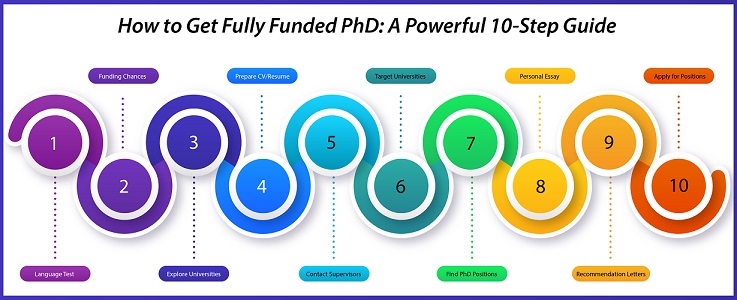
Your choice of doctoral program may be influenced by funding. In particular, most PhD opportunities provide financial aid in terms of scholarships, fellowships, or teaching/research assistantships. Your eligibility for financial assistance is increased with a strong PhD application. Making yourself seem like a wise investment is part of admission optimization. Having financial stability allows you to concentrate on your education; therefore, learn how to get fully funded PhD positions.
Conclusion
Pursuing a master’s or doctoral degree is a major step toward intellectual and professional growth, but success requires both ambition and strategy for admission optimization. A clear understanding of universities’ requirements, a competitive CV, a strong essay, and early preparation are all crucial. Whether applying to self-funded or fully funded programs, optimizing each component of your application can significantly improve your chances. Stay authentic, highlight your unique strengths, and DO NOT let setbacks define your potential. With a strategic approach and thoughtful planning, you can stand out in the competitive admission landscape and secure your place in a master’s or PhD program that matches your goals and values.
Frequently Asked Questions (FAQs)
Can I still apply for a doctoral program if I don’t have research publications?
Yes, while publications strengthen your application, strong research experience, a compelling personal essay, and strong recommendation letters can also demonstrate your potential.
Do all PhD programs require a master’s degree?
Not always. Many PhD programs accept direct applications from bachelor’s degree holders (with exceptional academic records), especially for research-intensive fields.
How can I find universities that match my CV?
You can compare your profile with admitted students via forums like GradCafe or use AI tools like Applyindex, which assess CV strength and suggest suitable universities.
0 Comment