


The Fulbright scholarship was initiated in 1946 to increase mutual understanding and support peaceful relations between the people of America and other countries. President Harry Truman signed the Fulbright Act into law in August 1946. The Fulbright program is divided into two main categories: the Fulbright Foreign Student Program (known as Fulbright scholarships for international students) and the Fulbright US Student Program. They are awarded to graduate students through master’s and doctoral programs. Please note that postdoctoral fellows are supported through the Fulbright Scholar Program. Non-U.S. citizens who have legal PR status in the USA are ineligible for any Fulbright grants. This article only focuses on the Fulbright scholarship for international students seeking funded graduate positions in the USA.
Fulbright Program Timeline and History
The Fulbright timeline has a remarkable history that every aspiring student should know. For instance, the year 1954 is remembered as the Year of Seven Fulbright Nobel Prize Laureates. That year, future Fulbrighter Linus Pauling won the Nobel Prize in Chemistry, while six other future Nobel Laureates received Fulbright awards: Milton Friedman, Philip Anderson, William Fowler, Niels Jerne, Roy Glauber, and Hannes Alfven. In 1958, Jeff Davis Duty became the first Fulbrighter with a disability, pursuing his scholarship at the London School of Economics. Another milestone came in 1972, when Fulbrighter Harrison Schmitt walked on the moon. In 1993, the Fulbright Association awarded its first Fulbright Prize for International Understanding to Nelson Mandela. You can be part of this history!
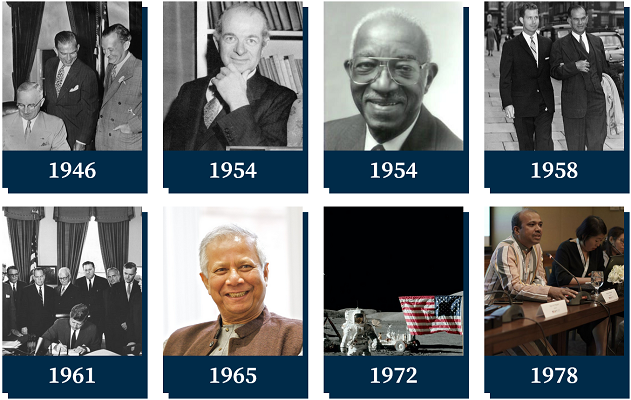
Fulbright Foreign Student Program
The Fulbright Foreign Student Program (FFSP) is among the best scholarships in USA. It enables international graduate students to study for a master’s or doctoral degree and conduct research on university campuses across the USA. Students cannot apply for programs with clinical requirements, such as dentistry, medicine, pharmacy, and nursing. Please note that fields of study such as public health and nursing administration are permitted. The FFSP operates in more than 160 countries worldwide. Approximately 4,000 foreign students receive Fulbright scholarships each year. The Fulbright Program encourages applications from all backgrounds, especially those with disabilities. The Fulbright benefits for international students include J-1 visa sponsorship, a monthly stipend (full funding), health insurance, and enrichment activities.
Fulbright Eligibility Requirements – Foreign Student Program
The Fulbright applicants must reside in the country of nomination at the time of application. At the time of the program start date, they must hold the equivalent of a US bachelor’s degree with a good academic record. They must be fluent in English, as demonstrated by a recent English proficiency test score of 550 (TOEFL PBT), 80 (TOEFL iBT), or 6.5 (IELTS Academic). Test scores can be submitted to the Institute of International Education (IIE) by indicating the institutional code of 2326 on the test day. The application must not hold US citizenship, and dual citizens are not eligible for program participation. Additional Fulbright eligibility requirements differ by country of citizenship.



How to Apply for Fulbright Foreign Student Program
The Fulbright Foreign Student Program is administered by binational Fulbright Commissions/Foundations or US Embassies. All FFSP applications are processed by these offices. Fulbright eligibility, application processes (called placement approach here), and selection procedures vary widely by country. Please use the drop-down menu at the end of this page to find information about the Foreign Fulbright Program in your home country. Please also discuss the US university admission and placement approach with the Fulbright office in your home country. Reviewing a Fulbright scholarship guide in your home country before applying can help you understand which placement model is best for you.
Placement Options for FFSP Applications
There are two placement models: IIE-Placement and Self-Placement. In the US, the IIE and AMIDEAST administer the Fulbright Foreign Student Program on behalf of the US Department of State. IIE administers the Foreign Fulbright Program for Africa, Eurasia, Europe, East Asia and Pacific, South and Central Asia, part of the Middle East, and the Western Hemisphere. IIE is the longest-running administrative agency and has been administering the program since its inception in 1946. AMIDEAST administers the FFSP for most of the Middle East and North Africa.
IIE-Placement Option
IIE’s Placement service helps Fulbright candidates obtain both degree and non-degree study opportunities. Applicants must submit their Fulbright application and all required documents to their local Fulbright office by the specified country or award deadlines. Using the details provided in the application, the Placement Team applies to US institutions on behalf of candidates, often securing application fee waivers. They also handle admission decisions, negotiate funding, and make final acceptance or rejection decisions on behalf of the candidates. Throughout this process, the Placement Team serves as the primary contact for US institutions, while candidates communicate with universities directly only when necessary. Visit here for more information and detailed instructions.
Self-Placement Option
In the self-placement approach, international candidates apply for Fulbright scholarships through the universities’ websites and manage their own applications. Candidates are responsible for submitting materials and test scores per each university’s deadline and application requirements, including any associated fees or deposits. IIE is not involved in the application process for self-placed candidates. Candidates secure their own admission, possible university funding, and tuition awards independently. Visit here for more information and detailed instructions.
Conclusion
The Fulbright scholarship program has become one of the most prestigious fully funded scholarships for international students to do a master’s or PhD in the USA within a systematic timeline starting from 1946. With its history of producing Nobel laureates, astronauts, and world leaders, Fulbright stands as a symbol of academic excellence and cultural exchange. Whether through IIE-placement or self-placement, candidates gain access to top US universities with academic, cultural, and financial support. By following country-specific guidelines and meeting Fulbright eligibility requirements, motivated applicants can transform their academic and professional futures. The FFSP program continues to empower global leaders and strengthen cross-cultural understanding worldwide.
Frequently Asked Questions (FAQs)
What is the Fulbright Scholarship?
It is a US government-funded program offering full funding for master’s and PhD programs, as well as research opportunities for international postdoc researchers. It is called the Fulbright Fellowship in some countries, like India.
How competitive is the Fulbright scholarship?
Fulbright is highly competitive, with selection based on academic merit, leadership, and clear goals, but strong, complete applications stand out.
Who is eligible for a Fulbright scholarship in the US?
Fulbright eligibility varies by country, but generally, applicants must have a strong academic record, English proficiency, and no US citizenship.
Do the Fulbright scholarships cover all expenses?
Yes, Fulbright usually covers tuition, airfare, living expenses, and health insurance, though some fellows may need extra funds.
Can I choose any field of study under the Fulbright scholarships for international students?
Most fields are eligible, except clinical programs such as medicine, dentistry, and pharmacy.
How do I apply for a Fulbright scholarship?
The local Fulbright offices or US embassies manage applications. Applicants must follow country-specific guidelines and deadlines.
When are the Fulbright scholarship application deadlines?
Application deadlines vary by country, but most programs open in early spring and close by mid-fall. Always check your local Fulbright office for exact dates.

Leave Your Comment